
Finally, after months of anticipation, Virgin Australia is allowing pets to fly in the cabin on selected domestic Virgin flights within Australia. Interested in booking your pet to fly in the cabin on a dog-friendly Virgin Australia flight? Read on to find out the full details of the Virgin Australia pet policy.
Are Dogs Allowed to Fly in the Cabin on Virgin Flights?
Up until recently, pet dogs were not allowed to fly in the cabin on Virgin Australia flights. This applied both on domestic flights and international flights operated by Virgin Australia.
However, Virgin’s pet policy changed on 16th October 2025. Virgin Australia now allows both pet dogs and cats that meet all the criteria to fly in the cabin on selected domestic flights. The trial was initially for flights up until 30th January 2026, but has now been extended and Virgin has announced it intends to continue the service.
Note that this change in policy only applies to pets. Assistance animals including guide dogs, hearing dogs and other assistance animals are already permitted to fly in the cabin on Virgin flights. There is no change in this policy, although it is noted that pets flying the cabin should give priority to service animals at security screening and pet relief areas.
Additionally, pets can also fly on Virgin domestic flights in the cargo hold, with no change to this policy. See below for more information on flying pets in cargo on Virgin flights.
Which Virgin Flights Allow Pets?
Currently, pets are only allowed to fly in the cabin on selected Virgin domestic flights. Pets are allowed on flights between Melbourne and Sunshine Coast (both dogs and cats) and Melbourne and Gold Coast (also now both dogs and cats). Pets can be booked onto flights in either direction between these cities up until 30th September 2026.
In June 2026, Virgin announced that they will add Adelaide to the network of flights where pets are allowed in the cabin, starting 23rd June 2026. Pets are allowed on flights between Adelaide and Melbourne (up to 31st January 2027) and flights between Adelaide and Gold Coast (up to 30th September 2026).
There are reports that Virgin will next add Launceston to the network, plus may even roll out their network of pet-friendly flights further in 2027. Hopefully my home city of Sydney is finally added!
Size Restrictions for Dogs in the Cabin
Only small dogs and cats are permitted to fly in the cabin on pet-friendly Virgin flights. There is a combined weight limit of 8kg for the pet and their carrier bag (so under 7kg for the pet alone, as carrier bags weigh at least 1kg).
This is similar to the weight limits for pets to fly in the cabin elsewhere in the world, in particular European airlines. In my guide to European airlines, only a handful of airlines have a higher weight limit than 8kg, and some airlines even have a lower weight limit.
Pets will also need to fly in an approved pet carrier – see below for the full details including dimensions. Your dog will need to be able to stand, turn, and lie down comfortably inside their carrier. This means long legged dogs that weight under 8kg but cannot stand up inside an approved carrier bag will still not be accepted in the cabin.
Requirements for Pet Carrier Bags
Note: This post contains affiliate links, which means I may receive commission if you make a purchase using the links. See my full disclaimer.
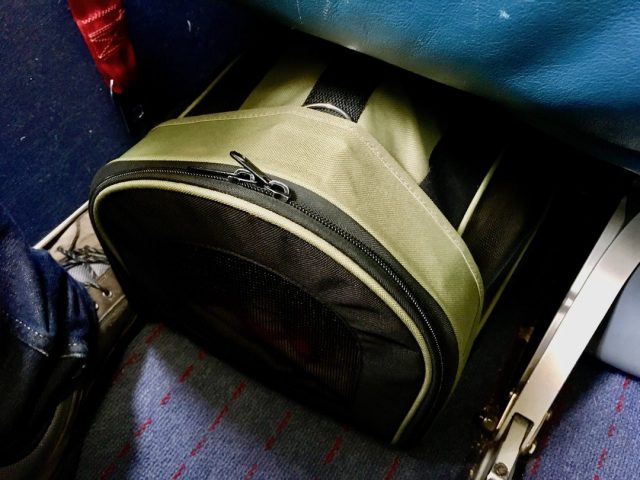
Pets will need to fly in a soft-sided approved pet carrier bag on Virgin flights – they aren’t permitted to simply sit on your lap. Instead, they will need to fly securely zipped up in this carrier bag underneath the seat in front of you, that can’t be opened during the flight. (Be prepared to sacrifice your leg room!)
The carrier bag is limited to a maximum size of 44cm wide x 26cm deep x 28cm high, so that it can fit underneath the seat in front. (And as it’s soft-sided, there’s some squish factor if needed.) This is almost exactly the dimensions of my dog’s carrier bag (see below), which I purchased while living in Europe with my dog.
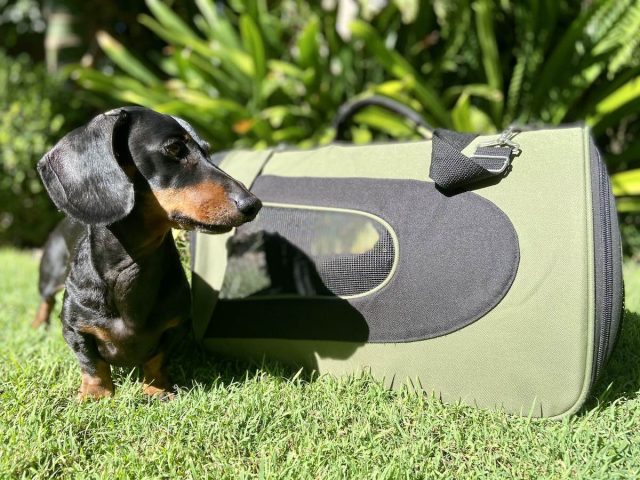
Other requirements for the carrier bag include that it needs to be escape-proof (so not a tote that doesn’t zip up) and well-ventilated. The base needs to be leakproof and it should be lined with an absorbent mat, with another absorbent mat put underneath it on the plane floor.
A pet carrier available to buy from Petbarn that meets these requirements is the All Day Pet Carrier. Another possible pet carrier that you can order off Pet Circle is the All for Paws Pet Travel Cabin Carry Bag. (Just double check that the bases are leakproof, plus that your pet comfortably fits in their carrier.)
Extra Criteria for Pets Flying in the Cabin
To be eligible to fly in the cabin on Virgin flights, pets must be at least eight weeks old, be up to date on their vaccinations, not be a prohibited breed (for the short list see the Virgin website) and not have given birth within the last two weeks.
Pets may be required to have a valid veterinary certificate, completed within 14 days of your pet’s flight. This applies for pets that are between 8 and 12 weeks of age, are over 12 years old, are pregnant, have a medical condition or are unwell, have recently sustained an injury, have had surgery in the last two weeks, or if they need to be sedated. Brachycephalic or snub-nosed breeds require both a veterinary certificate and a special form.
Criteria for Passengers Flying with Pets
Only a single pet can fly per passenger, due to the pet needing to travel underneath the seat in front. Passengers that are travelling alone with an infant, are under 18 years and travelling alone, or are travelling with an assistance dog are ineligible to travel with a pet in the cabin.
Booking a Dog in the Cabin
Bookings for pets in the cabin on Virgin flights are only possible through Virgin’s Guest Contact Centre, not online. This way contact centre staff can ensure that all the rules for pets flying in the cabin will be met, such as the weight limit and use of a soft-sided carrier. Bookings are only accepted up to 72 hours before the flight.
Only a maximum of four pets per flight is permitted, allocated to four specific seats in economy class – the window seats 18A, 18F, 20A and 20F. No pets are allowed in business class.
Currently, an introductory fee of $149 per flight applies for pets flying in the cabin. Virgin notes that this fee may be varied at any time; presumably it will be increased once the trial is over.
At the Airport and On Board the Flight
When flying with a pet in the cabin, you’ll need to check-in at the airport in person, no later than 75 minutes before departure (earlier than the usual check-in cut-off time). At this point your pet, their carrier bag and their veterinary certificate (if required) will be checked over.
At the airport, pets are not allowed to be taken out of their carrier bag except when visiting animal relief areas or when going through security. When going through security, always take your pet out of their bag – they go through with humans, not the bags.
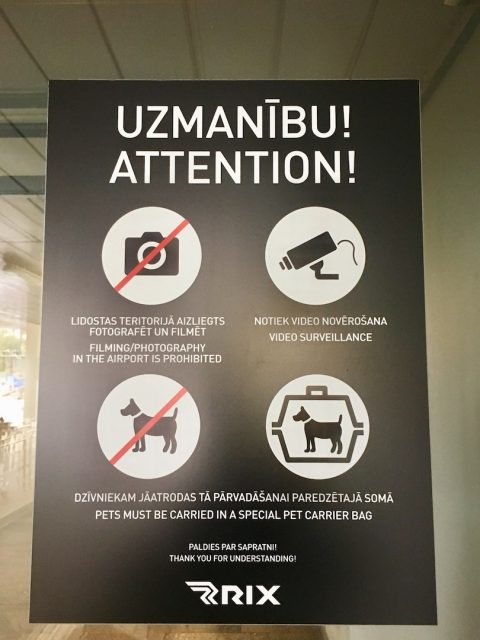
Pets must wear a collar or harness throughout their journey, and be restrained on a leash when they are removed from their carrier at security or at animal relief areas. It’s recommended that collars and harnesses have minimal metal (so the detectors are not set off at security), with bark collars not permitted.
At least Melbourne Airport has animal relief areas available to both service dogs and now pets flying in the cabin. Virgin Australia domestic flights fly out of T3 – an animal relief area is located next to the Lego store in T4 after security, also accessible from T3.
At the airport, pets are not allowed in any Virgin Australia lounges or inside any food and beverage outlets, in order to be compliant with food safety regulations.
Pets are not allowed to be taken out of their carrier bag onboard the flight, even if your pet needs a bathroom break – this is why absorbent mats should be used the base should be leakproof. If an accident occurs, you’ll need to deal with it at your destination.
However, in my experience, most dogs that are no longer puppies can hold on longer than expected. (I’ve flown with my dog in the cabin on flights up to 8 hours and he didn’t need a bathroom break.)
According to reports from the first day of Virgin’s new pet policy, after passing through security zip ties are attached to the carriers of pets to ensure they aren’t opened on the flight. (Bring nail clippers in your hand luggage or ask a staff member at the other end to cut this off.)
My Experience Flying with Virgin
Unfortunately, I haven’t yet experienced flying with my pet in the cabin on a Virgin Australia flight. I was hoping to fly on one of the first pet-friendly flights. However, I live in Sydney and the trial flights are in between Melbourne and the Sunshine Coast or Gold Coast. But as soon as there are pet-friendly flights operating out of Sydney, my dog Schnitzel and I will be onboard!
I have extensive experience at flying with Schnitzel in the cabin on overseas flights, including flights in Europe, the United States and even a Trans-Atlantic flight between Europe and the US. The rules for flying with pets in the cabin on Virgin flights are very similar to the rules overseas, so let me know if you have any questions or would like some tips.
Flying with Dogs in the Hold on Virgin Flights
Pets can also fly on domestic Virgin flights in the cargo hold, booked through Virgin Australia Cargo. This option will continue to exist for larger dogs who are too large to fly in the cabin, or smaller dogs flying unaccompanied.
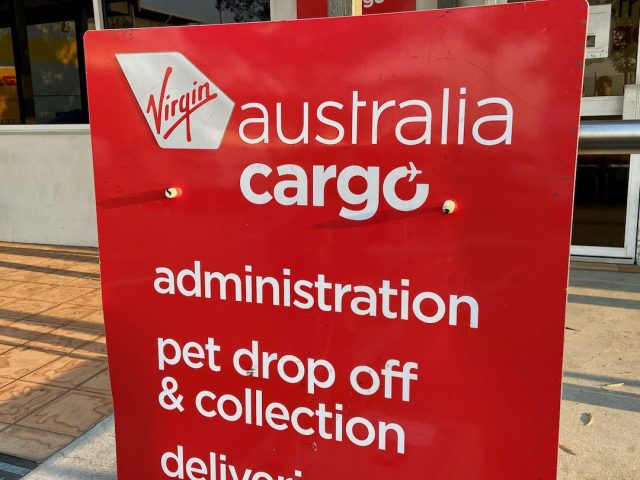
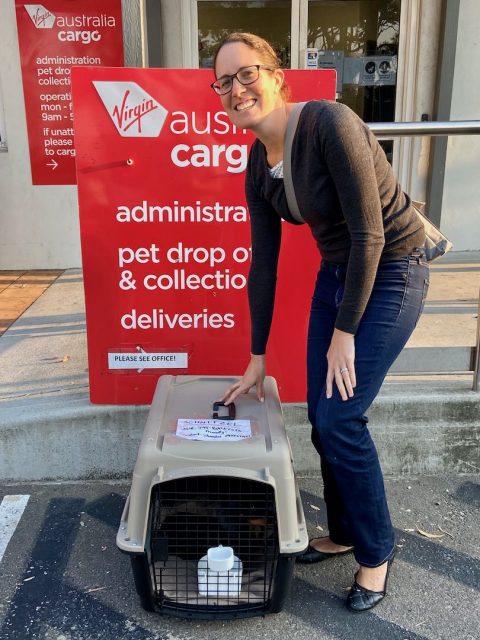
Back in 2019, when flying from Sydney to Melbourne, my dog Schnitzel experienced flying in the cargo hold on a Virgin flight. The rules and regulations for pets flying in the hold on Virgin flights are still largely the same as back then. I cover the experience in extensive detail in this guide.
You can make a booking directly with the Virgin Australia Cargo team via the phone or email, or alternatively through one of their pet transport partners. The price to fly pets with Virgin has likely increased since I flew. (The rates charged by Qantas have certainly increased.)
When flying in cargo, pets are dropped off and picked up from the freight terminal. They generally fly in a hard plastic crate. To find out the ideal crate size for your dog, Virgin have guidelines on their website. They also provided an extensive list of requirements for crates.
Virgin Australia has a maximum weight limit for pets flying in cargo – 65kg including your dog’s crate. (However, since February 2026, they will consider heavier pets on a case-by-case basis.) There may also be size restrictions on flights that are not operated by Boeing 737 aircraft. For brachycephalic (snub-nosed) breeds, additional requirements apply.
You May Also Like
- Best Pet Carriers for Flying in the Cabin with Virgin
- Flying with a Dog in Australia: The Ultimate Guide
- Flying To or From Melbourne Airport with a Pet in the Cabin
- Flying with a Pet in the Cabin in Europe
About the Author
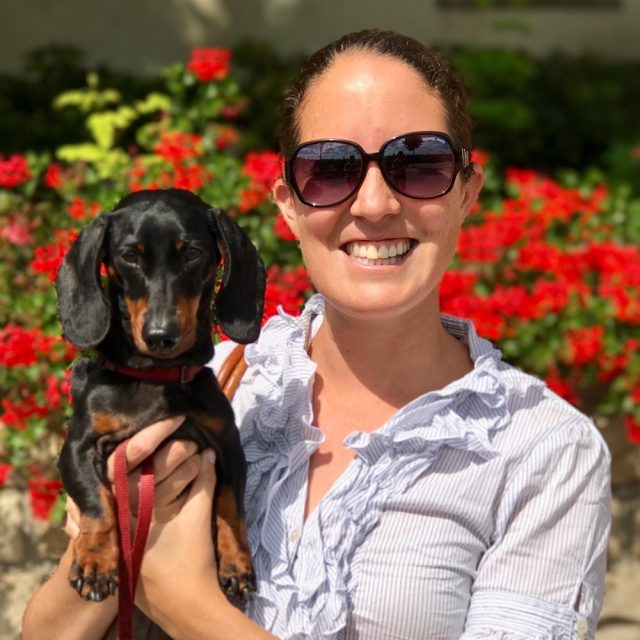
Shandos Cleaver is the founder of Travelnuity: Dog-Friendly Travel. She has travelled extensively with her Miniature Dachshund, Schnitzel, including to 33 countries across Europe, every state and territory of Australia except Tasmania, and 10 of the United States. She’s passionate about providing inspiration and information to others wanting to travel with their dogs, whether close to home or internationally.