
Since the end of the Brexit transition, it’s become more difficult to travel with your dog from the United Kingdom, specifically Great Britain, to the Republic of Ireland, but it’s still possible. Find out more about the paperwork required to travel with a dog, plus the ferries that you can take to Ireland.

Can I Take My Dog to Southern Ireland from the UK?
Yes, it’s possible to still take your dog from Great Britain to the Republic of Ireland (ROI), or “southern” Ireland. However, since the end of the Brexit transition it has become harder, with more paperwork required and it likely to be checked, unlike when crossing the Irish Sea on a ferry in the past.
Some people ask whether it’s possible to take a dog to Ireland without a “pet passport”. However, unlike before Brexit, pet passports no longer exist in Great Britain. Instead, find out about the new paperwork requirements.
Paperwork to Take a Dog to Ireland from the UK
The steps required to travel with your dog from Great Britain to the ROI are the same as the steps to travel to any other European Union country, with the addition of a worming treatment.
Firstly, your pet will need to be microchipped. They then need to vaccinated against rabies, at least 21 days before the date of travel, with only vaccinations after microchipping counted as valid.
The ROI is also one of the EU countries where a tapeworm treatment is required. (Previously, dogs travelling directly from the UK to the ROI were exempt, but this is no longer the case.) A vet needs to administer this between 24 hours and five days (120 hours) of your arrival in ROI.
Then you need to get an animal health certificate (AHC) for your dog, which will record all these steps. This needs to be completed by a vet within 10 days of your entry to the EU.
Alternatively, if you have a EU pet passport issued outside of Great Britain with a valid rabies vaccination (and you are an EU resident), you can use this, with the tapeworm treatment recorded in it. For more information, see the UK government website.
Prior to the end of the Brexit transition, while paperwork was required to travel to ROI from the UK, it was rarely checked. Be prepared for your paperwork to be checked.
Taking a Ferry with a Dog to Ireland
There are multiple pet-friendly ferries available to cross from Great Britain to the Republic of Ireland with your dog. Each of the four ferries depart from Wales, sailing out of Holyhead, Fishguard or Pembroke. While dogs were previously permitted on the P&O ferry from Liverpool to Dublin, they are no longer allowed onboard this ferry.
Taking the Stena Line Holyhead to Dublin Ferry
Stena Line operates a ferry crossing from Holyhead (in northern Wales) across to Dublin. There are generally four crossings daily on this route, that takes about 3hr 15mins each way. There are three options available for travelling with pets.
Firstly, your pet can remain in your vehicle (if you are travelling by car). Secondly, you can book a kennel for your pet. Both of these are free of charge, although pets must be pre-booked for either option (on the “Stena Plus & Onboard Extras” step of the booking process).
The third option is to book a pet-friendly cabin. Up to two pets are permitted in each vinyl-floored pet-friendly cabin, with water bottles and pee pads provided. Bookings are available both online and through the call centre; make sure you book well in advance.
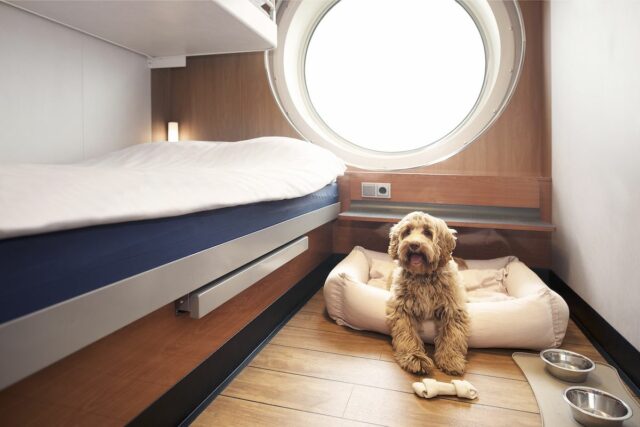
On the Stena Estrid on the Holyhead to Dublin, there’s a dedicated outdoor area, where you pup can get some fresh air and have a toilet break. However, on the Stena Adventurer this is not available – pets need to stay in the cabin. Use a non-retractable leash or carrier for your pet.
Click here for more information (Scroll down for route specific information)
Taking the Stena Line Fishguard to Rosslare Ferry
Stena Line also operates a pet-friendly ferry from Fishguard (in southwestern Wales) to Rosslare. There are two crossings per day on this route, that takes about 3hr 30 mins or 4hr.
The options available for travelling with a pet are similar on this route, as for the ferry from Holyhead to Dublin, with pet-friendly cabins also available. However, there are no outdoor area for dogs on the ferries operating on this route. Pets need to stay in your cabin, if you book one.
Click here for more information (Scroll down for route specific information)
Taking the Irish Ferries Holyhead to Dublin Ferry
The second company operating ferries between Great Britain the ROI is Irish Ferries. Just like with Stena Line, they also operated a Holyhead to Dublin ferry, departing from northern Wales. There are up to four crossings daily, each taking around 3hr 15 mins.
Recently, the options for pets sailing with Irish Ferries have been upgraded. There is now a Pet Den Area onboard the James Joyce and the Ulysses ferries on this route. This area is a dedicated inside lounge with seating for owners, including snack and drink service, plus pet hooks. There is also access to an outdoor deck area.
The other alternative if to book a pet-friendly cabin. There are now also six pet-friendly cabins onboard the James Joyce ferry operating on this route (but not on the Ulysses ferry).

Additionally, there is the option to leave your pet in your own vehicle or book one of the various sized pet kennel on the car decks. Pets need to be pre-booked, choosing an option, to ensure availability. However, there is no fee to travel with pets.
If travelling on foot, while all these options (other than leaving your pet in your vehicle) are available, it’s required you you carry your pet to and from the ferry in your own secure, rigid pet cage or box. Note that some Holyhead to Dublin ferries don’t accept foot passengers.
Click here for more information
Taking the Irish Ferries Pembroke to Rosslare ferry
The final ferry option to take your dog from Great Britain to Ireland is the Irish Ferries route from Pembroke (in southwestern Wales) to Rosslare. There are two crossings per day on this route, which is longer – taking about 4hr.
Like on the ferries on the Irish Ferries Holyhead to Dublin route, there is also a Pet Den Area onboard the Isle of Innisfree ferry sailing on this route. However, there are no pet-friendly cabins on the ferries on this route. There is also the option to use a pet kennel or leave your pet in your vehicle.
Just like on the other route, there is no charge for bringing along a pet, although advance bookings are essential. Also, passengers on foot bringing aboard a pet need to carry them onboard in their own secure, rigid pet cage or box.
Other Alternatives
The other alternative is take a a ferry from Great Britain to Northern Ireland, and then drive across the border to the Republic of Ireland. There are multiple ferries that operate to Northern Ireland. Find out more about the options and the paperwork required in my guide to travelling to Northern Ireland.
Returning to Great Britain
To return to Great Britain with your dog, generally you will just need to show the AHC that you initially used to travel to the ROI. This certificate is valid for up to six months (previously four months) since you entered the ROI using it. If longer than six months has passed, there are alternatives.
While a worming treatment was required to travel from Great Britain to the ROI with your dog, the UK government states that this is not required from returning to the UK from Ireland. Thus, as long as your AHC is still valid, you won’t need to visit a vet.
You May Also Like
- Taking a Dog From Northern Ireland to Southern Ireland
- Travelling to Republic of Ireland with a Dog
- Travelling to Northern Ireland with a Dog
- Dog-Friendly Ireland Guide
- Travelling To and From the UK with a Dog
About the Author

Shandos Cleaver is the founder of Travelnuity: Dog-Friendly Travel. She has travelled extensively with her Miniature Dachshund, Schnitzel, including to 33 countries across Europe, every state and territory of Australia except Tasmania, and 10 of the United States. She’s passionate about providing inspiration and information to others wanting to travel with their dogs, whether close to home or internationally.