
While it’s easy to travel around the United Kingdom with a dog, it’s a bit trickier if you want to leave the UK, especially since Brexit, with the new requirement for an animal health certificate. There is talk about a new pet passport being introduced, but there aren’t yet any definite details.
Also keep in mind that there are paperwork requirements to return to the United Kingdom with your dog, in particular a worming treatment, that applies equally to both UK and foreign dogs.
Read on to find out more about the steps to travel from UK to other countries and the requirements to then return to the UK…

Travelling from the UK to the Republic of Ireland
The easiest country to visit from the United Kingdom with your dog is the Republic of Ireland.
If you’re already in Northern Ireland, it’s as simple as driving across the border. Generally no checks are made, although it is expected you have a pet passport with a valid rabies vaccine.
On the other hand, if you are visiting Northern Ireland from Great Britain using a Northern Ireland pet transport document, this does not permit you to travel on to the Republic of Ireland with your dog. For more details, see my guide to taking a dog from Northern Ireland to Southern Ireland.
It’s also fairly easy to visit the Republic of Ireland from Great Britain with your dog, with a wide range of ferries that allow dogs onboard, generally departing from Wales. In recent years, the facilities on the ferries have improved, with many offering pet-friendly cabins.
When travelling to Ireland from Great Britain with a dog, your dog will require a rabies vaccination and an animal health certificate, the same as for other European Union countries. Dogs also require a tapeworm treatment administered by a vet. For more details, see my guide on taking a dog from Great Britain to Southern Ireland.

Travelling from the UK to Continental Europe
It’s a touch harder to travel from the UK to Continental Europe with a dog. This is especially the case if you are not driving, given the Eurostar to and from London doesn’t allow pet dogs. While a number of airlines fly pets out of the UK in the cabin, this is not possible for the return trip.
The simplest option for visiting Continental Europe with your dog is by car, either taking LeShuttle or one of the many ferry options, including the short crossings between Dover and Calais. Pet lounges are now available on multiple ferries.
If you are not travelling by car, there are four ferry options that allow foot passengers to take pets on board, mainly crossing to the Netherlands, plus the DFDS ferry to Dieppe in northern France.

For more detailed information, check out my main guides:
- How to Travel Between the UK and Europe with a Dog
- Flying Out of the UK with a Dog in the Cabin
- Pet-Friendly Cabins on Ferries Between UK and Europe
- Stena Line Ferry With a Dog: Harwich to Hook of Holland

I’ve also put together multiple guides on travelling to France:
- How to Travel from UK to France with a Dog
- Taking Dogs on the Ferry to France from the UK
- DFDS Seaways Ferry with a Dog: Dieppe to Newhaven
And multiple guides on travelling to Spain:
- How to Travel from UK to Spain with a Dog
- Can I Take my Dog to Spain by Car from the UK?
- Taking a Ferry to Spain with a Dog from the UK
- How to Fly a Dog to Spain from the UK

Paperwork to Travel to Europe with a Dog
Since Brexit, the requirements to travel to Europe with a dog have become slightly more complicated. The main elements still apply: your dog is required to have a microchip and an up-to-date rabies vaccine.
However, the big change is that pet passports issued within Great Britain are no longer valid. If you don’t have an EU-issued or Northern Ireland-issued pet passport (and you’re a resident of either the EU or Northern Ireland), you will need to visit a vet for an animal health certificate (AHC).
The AHC is a ten-page bilingual document that needs to be issued by an official vet, within 10 days of your arrival in the EU. It is only valid for a single visit to the EU, for a period of up to six months (previously four months). A new one needs to be issued each trip.
Additionally, a worming treatment will now be required if you are travelling directly to Finland, Ireland, Malta or Norway with your dog from Great Britain, when this was not previously required. This is required between 24 hours and five days of entering the country and recorded on the AHC.

Prior to Brexit when travelling to Europe from the UK, paperwork for pets was not always checked. However, this is no longer the case, such as when boarding the Eurotunnel with a pet. Make sure that everything is order and allow additional time for your dog’s paperwork to be checked.
If you are travelling to multiple countries in addition to the first EU country you arrive in, make sure you have section 8 of your AHC signed, close to passport control. For further details, see the UK government website.
Recently, there have been mentions that pet passports will be returning to Great Britain. However, there are still no definite timeframes for this to occur.
Travelling Back to the UK with a Dog
When travelling back to the UK with a dog, virtually the same transport options are available, as included on this list of approved routes. The one difference is that no airline is permitted to fly pet dogs in the cabin or as checked baggage, only as cargo. This is a government regulation.
This means that if you fly out of the UK with a pet in the cabin, you need to prepare another way to return to the UK. As well as the above mentioned ferries, another alternative is to use a pet taxi across the channel or a pet transport company.
For more information, see the guides linked above .
Paperwork to Travel to the UK with a Dog
Despite the UK having left the EU, travelling from Continental Europe to the UK with a dog is similar to travelling to another EU country. The rules have stayed virtually the same: a microchip, a pet passport or health certificate, and a rabies vaccine, given at least 21 days before arrival (or slightly longer for some rabies vaccines), are required.
For travellers from the UK, you can use the same AHC issued in Great Britain to travel to the EU to return to Great Britain, as long as less than six months (previously four months) has elapsed since you entered the EU.
Alternatively, you can enter using a pet passport issued in the EU and other countries, including those issued in Great Britain prior to 2021, or the new Great Britain pet health certificate, issued by a vet in the EU. For full details, see the UK website.
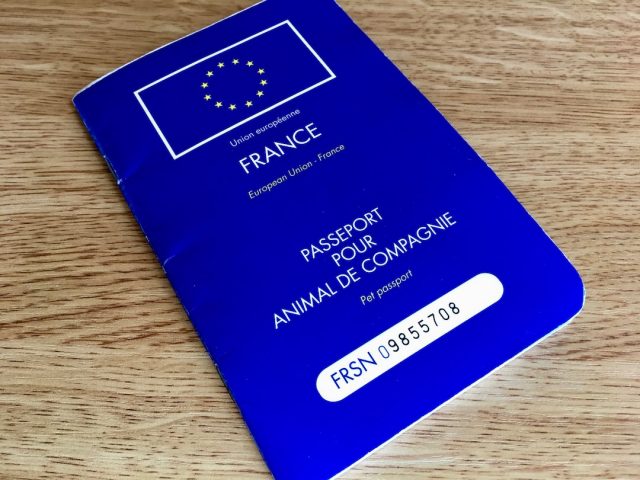
Dogs travelling to the UK require a worming treatment done by a vet (and recorded in their documentation), 24 hours to 120 hours (5 days) before their arrival, unless they are travelling directly from Finland, Ireland, Malta or Norway. If the AHC used to leave GB is still valid, an EU vet can record this treatment on it.
The record for this worming treatment is strictly checked, down to the hour. For pets returning to their home in the UK after a visit to the Continent, don’t miss out on this step.
In my experience, be prepared for border officials to thoroughly check your dog’s paperwork, including its rabies vaccination records. If you’re heading across to the UK on a ferry or driving your car onto the Eurotunnel, your pet’s paperwork is checked before departure, while still in Europe. If there’s an issue, you will not be able to board.
Travelling To or From the Rest of the World
Heading further afield than just Europe with your dog? I’ve put together a guide on travelling from the UK to the USA with a dog, covering the different transport options available. I’ve also put together a guide on travelling to the UK from outside of Europe, covering the most popular routes.
About the Author

Shandos Cleaver is the founder of Travelnuity: Dog-Friendly Travel. She has travelled extensively with her Miniature Dachshund, Schnitzel, including to 33 countries across Europe, every state and territory of Australia except Tasmania, and 10 of the United States. She’s passionate about providing inspiration and information to others wanting to travel with their dogs, whether close to home or internationally.